Painter
Oil on Canvas b. 1979, China
In the works of Chinese-Canadian artist Jeffrey Chong Wang, we encounter a range of vivid and varied imagery: the Tungusic people outside Yongdingmen, rebels conspiring in Taoranting Park, elderly people dancing in public parks, elementary school children rowing with both arms along the river, the powerful Vajra deity at Beihai Park, the central axis of Beijing, the Olympics, the Third Plenary Session of the 11th Central Committee, and workers commuting by bicycle against the wind.
Each of these images alludes to different historical and emotional contexts — China's early socialist era, imperial authority, the spiritual world of Vajrayana mandalas, someone's adolescence, and more. Some of these contexts may have receded from the stage of history, but they have never completely disappeared. These varied conditions collide with one another, generating a kind of tension — one that may even verge on the poetic.
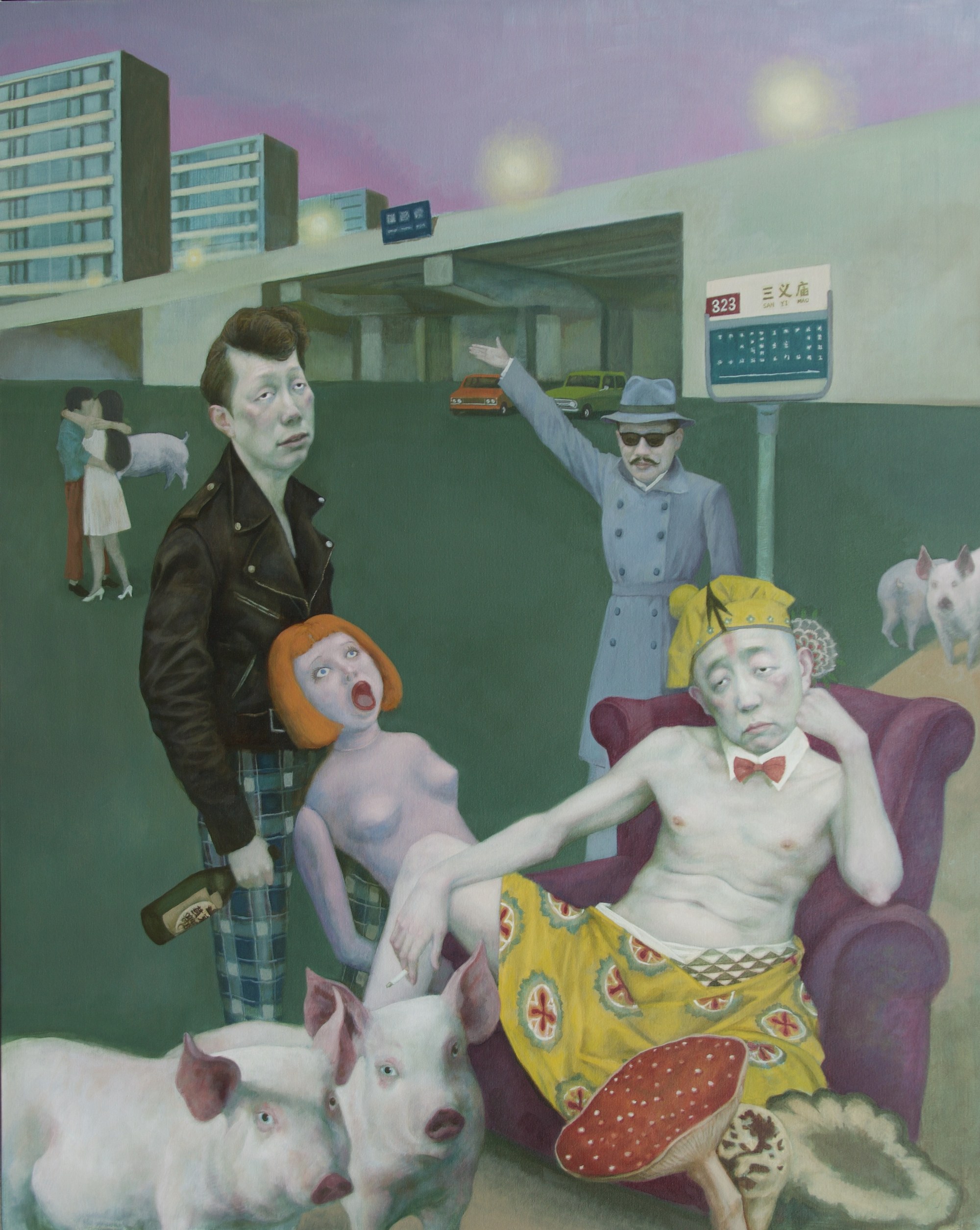
In recent years, the artist has faithfully depicted the faces of several close friends using the traditional language of oil painting. These individuals all possess "faces with stories," and Wang approaches them almost as literary figures — characters embedded in his paintings. A closer look reveals that these are people who carry a profound sense of helplessness in confronting the external world. In such moments, a posture of "feigned madness" becomes an attitude — a way of transforming helplessness.
In traditional Chinese culture, the notion of "feigned madness" (佯狂) is a familiar one. Mad monks and deranged hermits appear in countless classical novels and folktales. But in today's context, these figures come across as particularly awkward and absurd. Their madness has solidified into a fixed pose, and Wang seeks to convey this very awkwardness, absurdity, and the wild and boastful words that accompany them.
Solo Exhibitions
Selected Group Exhibitions & Art Fairs